

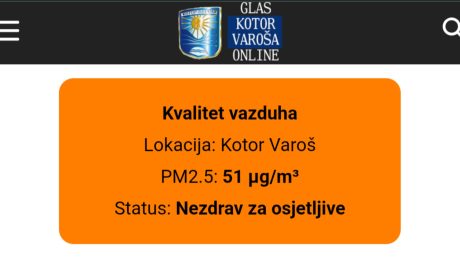
Kotor Varoš reports live on air quality
Thanks to the cooperation with the news portal Glas Kotor Varoš, in addition to the PurpleAir map, the current state of air quality in Kotor Varoš can also be monitored on their website: Početna – Kotor Varoš – Glas Kotor Varoša – Nezavisni online magazin We are working to ensure that residents of smaller towns
- Published in Uncategorized
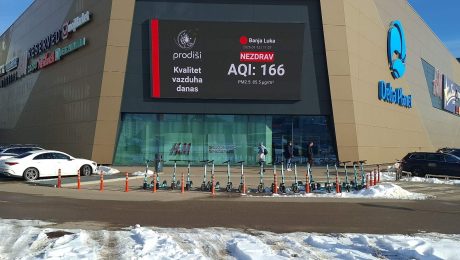
Live air quality monitoring via city billboards in Banja Luka and Sarajevo
Thanks to our collaborators from Metromedia group, we are able to show air quality live at several advertising locations in Banja Luka: department store Boska, Delta planet (inside and outside), “Bulevar”, as well as Dobrinja and Otoka in Sarajevo! This way the information reaches target groups that do not follow social networks nor online news,
- Published in Uncategorized

City Assembly councilors in Banja Luka undecided on adopting decisions to improve air quality.
In Banja Luka, on December 25, 2025, the 11th extraordinary session of the Banja Luka City Assembly was held, the second agenda item of which included a discussion on improving air quality through certain decisions and resolutions. The following items related to air quality were on the Assembly’s agenda: Proposal for a decision to ban
- Published in Uncategorized
Air pollution increases the risk of dementia by at least 14%
The Institute for Health Metrics and Evaluation (IHME) from the USA has conducted the largest study to date providing evidence of the link between air pollution and dementia. Airborne particles known as PM2.5 damage brain tissue and increase the risk of developing dementia. Every increase of 10 µg/m3 in the concentration of PM2.5 particles raises
- Published in Uncategorized
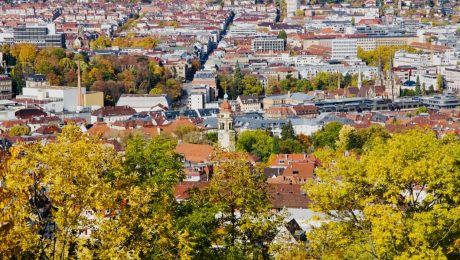
Ventilation corridors make Stuttgart a city that cools itself
Though being the capital of combustion engine (1886 – Mercedes Benz), entering and driving through Stuttgart will impress you with the amount of greenery along the streets and in parking areas. These corridors are not placed randomly — they are part of a plan designed to direct cooler air from the surrounding hills toward the
- Published in Uncategorized

Indoor air quality can be way worse than outdoor air quality
Researchers from the University of Birmingham in the United Kingdom measured particulate matter (PM) pollution in three households over a two-week period. They found that pollution levels indoors were higher and more variable than outdoors. One household exceeded World Health Organization limits for PM2.5 on nine out of fourteen days. Activities such as cooking, smoking,
- Published in Uncategorized

The impact of large wildfires on human health
Research has shown that, in addition to massive destruction and direct loss of life, wildfire smoke poses a health risk to populations far beyond the immediate fire zone. As many as 1.6 million deaths per year worldwide are attributed to wildfire smoke and its effects on respiratory diseases, heart attacks and strokes, worsening of type
- Published in Uncategorized

The story of little Ella
Ella was a little girl born in East London in 2004 with no health issues. She was active in sports and shared the same interests as her peers. When she turned seven, Ella began experiencing breathing difficulties, and after several hospitalizations, she was diagnosed with asthma. None of the available tests could identify the cause
- Published in Uncategorized

Bosnia and Herzegovina must urgently establish a unified pollution reporting system and ratify the PRTR Protocol after 22 years
Although Bosnia and Herzegovina is a signatory to the Aarhus Convention, it has still not ratified its key supplement — the PRTR Protocol — which requires publicly accessible registers of releases and transfers of harmful substances from industrial facilities into air, water, and soil. This protocol is essential for ensuring transparency, polluter accountability, and timely
- Published in Uncategorized
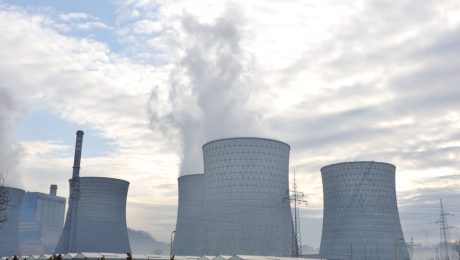
Outdated coal power plants are pushing Bosnia and Herzegovina into CBAM (Carbon Border Adjustment Mechanism) sanctions as early as January 1, 2026
*The latest report by the CEE Bankwatch Network shows that outdated coal-fired power plants in the Western Balkans once again exceeded emission limits in 2024: total sulfur dioxide (SO₂) emissions were six times higher than the legal limit set by the National Emission Reduction Plans (NERP) for Bosnia and Herzegovina, Kosovo, North Macedonia, and Serbia.
- Published in Uncategorized
- 1
- 2