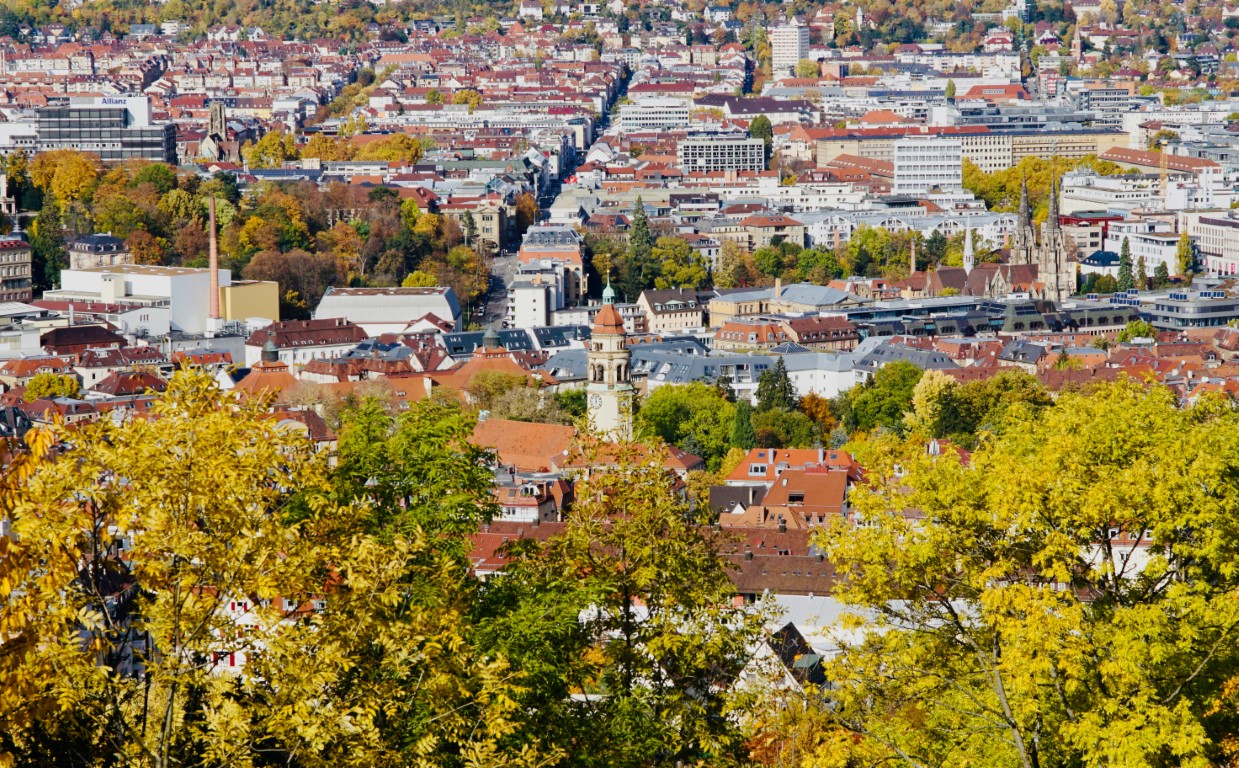

Though being the capital of combustion engine (1886 – Mercedes Benz), entering and driving through Stuttgart will impress you with the amount of greenery along the streets and in parking areas. These corridors are not placed randomly — they are part of a plan designed to direct cooler air from the surrounding hills toward the city center, allowing constant airflow that cools and cleans the air.
Cooling innovations are rooted in geography. The city lies in a relatively densely populated valley that traps pollutants from industry and traffic — as far back as 1938, residents began expressing concern about air quality, and that same year the institution of the “city climatologist” was established, responsible for monitoring temperature and air quality.
To fight pollution — and considering the city is on average 2–3 degrees warmer than its surroundings — the city administration has spent decades diligently protecting its “ventilation channels”: parks and corridors of water and trees that guide cooler nighttime breezes into the city. Some of these corridors have been planted on abandoned transport infrastructure, such as old railway lines, which have been transformed into green belts and water pathways to create a network of interconnected parks. Even solid infrastructure (e.g., a road with no nighttime traffic) can function as a ventilation channel, as long as it can guide natural wind patterns swirling at higher altitudes into the city.
A map of air flows, together with a map of PM concentration and a heat-island map, served as the basis for developing these corridors. The City Department of Climatology (which today has 13 employees) is also involved in reviewing construction permits to ensure these ventilation corridors are not disrupted.